

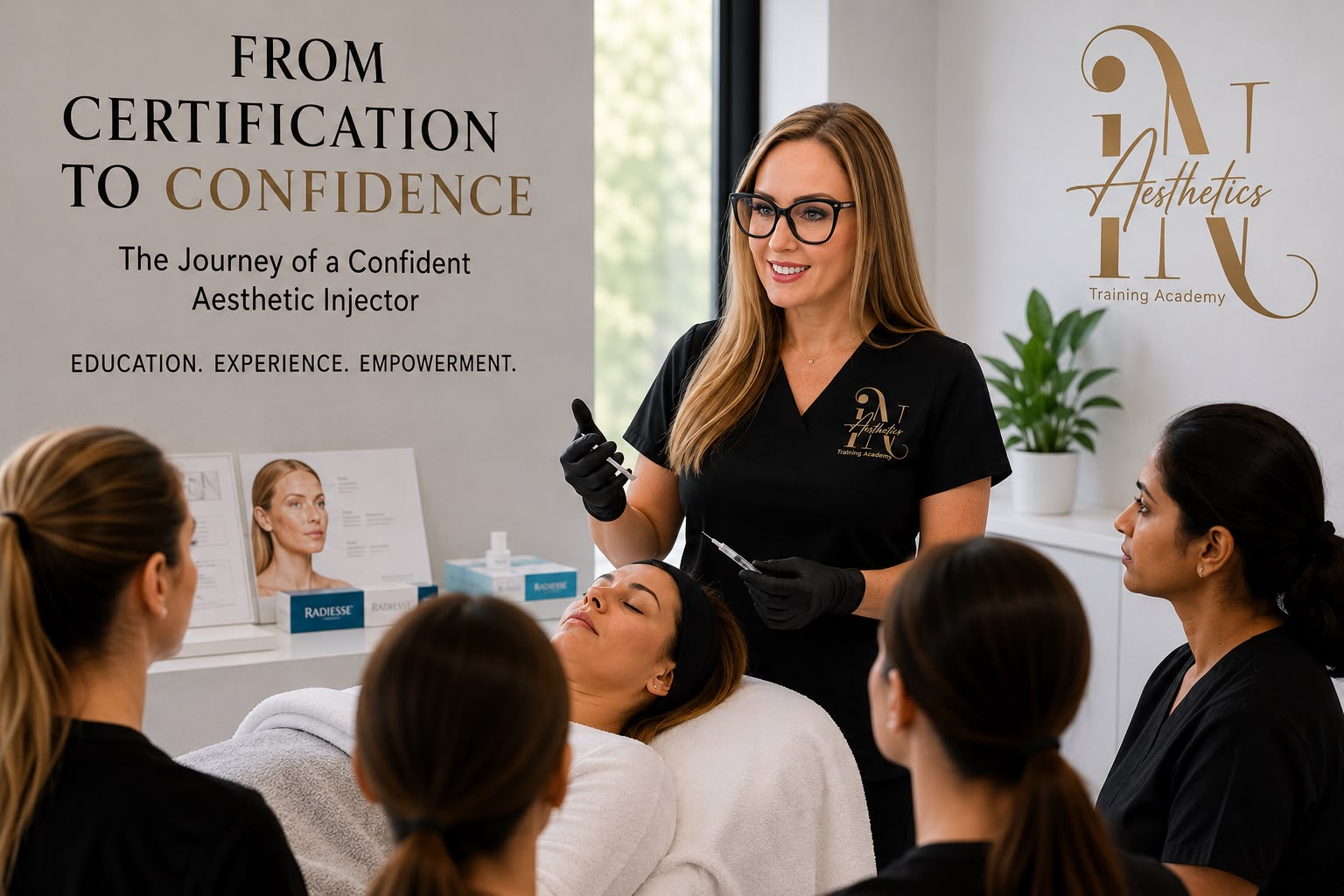
By Iwona Nasuto, MSN, RN | Founder & Clinical Educator, IN Aesthetics Training Academy
Completing your first medical aesthetics course is an exciting milestone. Whether you’ve just stepped away from a beginner Botox training course, finalized your first dermal filler certification, or are just mapping out your transition into medical aesthetics, earning that certificate is a major achievement.
But here is a fundamental truth I share with every student who walks through our doors:
A certificate allows you to begin your journey. It doesn’t build your confidence.
True clinical confidence is developed over time. It is forged through hands-on experience, continuous advanced education, dedicated mentorship, precise medical decision-making, and an unyielding commitment to patient safety.
This concept was the driving inspiration behind our recent webinar, “Certification of Confidence.” It served as an open, honest dialogue about what it really takes to transition from a newly certified injector into a safe, deeply skilled, and confident aesthetic provider.
Botox and Dermal Filler Training Is Just the First Step
One of the most widespread misconceptions in aesthetic medicine is that a weekend certification course fully prepares you for every clinical scenario you will encounter in private practice.
The reality is vastly different.
High-quality introductory training programs do an excellent job of teaching precise injection techniques, fundamental facial anatomy, and product rheology (the physical properties of products). These are foundational pillars. However, once you are standing independently in front of your first solo patient, an entirely new layer of critical clinical questions surfaces:
- How do you screen out inappropriate candidates during the consultation?
- How do you safely manage unrealistic patient expectations?
- How do you design a holistic, long-term treatment plan instead of simply playing “line-chaser” with a syringe?
- How do you confidently identify when not to inject?
These nuances cannot be resolved by a paper certificate alone. They require sharp clinical judgment, ongoing peer support, and a structured path of continued learning.
Clinical Confidence Is Built, Not Awarded
Many new injectors share that they are waiting for a specific day when they will suddenly “feel completely confident.”
Realistically, clinical confidence doesn’t arrive overnight. It is an incremental asset built with:
- Every comprehensive facial assessment you complete.
- Every patient interaction and anatomical variation you analyze.
- Every advanced injectable course you pursue.
- Every direct conversation with an experienced medical mentor.
In my years as a clinical educator, the providers who achieve the highest levels of long-term success aren’t necessarily those with the longest row of certificates displayed on the wall. They are the practitioners who remain intensely curious, protect their clinical humility, and never stop learning.
Treat the Whole Patient, Not Just the Procedure
Aesthetics should never become transactional. Patients frequently walk into a clinic requesting a singular, highly specific treatment based on what they saw online:
- “I just want a syringe of lip filler.”
- “I need Botox in my forehead.”
- “I think I need more cheek volume.”
As licensed healthcare professionals, our ethical responsibility is to look past the immediate request to identify the underlying anatomical cause.
Sometimes, dermal filler is the ideal solution. In other cases, improving skin quality via advanced skin rejuvenation therapies is the superior route. Frequently, modern regenerative aesthetics will deliver the subtle, balanced, and long-lasting results the patient actually desires. And occasionally, the most professional recommendation you can make is to advise them to wait—or decline treatment entirely.
The most successful consultations never begin with a pre-filled syringe. They begin with active listening and expert facial assessment.
Why Regenerative Medicine Is Transforming Modern Aesthetic Practice
The landscape of aesthetic medicine has evolved dramatically over the last few years. Today’s patients aren’t looking for over-filled, artificial features; they are demanding healthier skin, natural symmetry, and graceful, long-term rejuvenation.
This paradigm shift is exactly why regenerative medicine has become a vital asset for modern practices.
Advanced biostimulators, such as Radiesse®, alongside targeted collagen-stimulating treatments, allow providers to trigger the body’s intrinsic cellular processes rather than merely inflating tissue with standard volumizers. These advanced modalities improve dermal structural integrity, boost natural collagen synthesis, and produce elegant, undetectable results that age beautifully.
Learning the science of regenerative medicine doesn’t replace foundational injectables like neurotoxins or traditional dermal fillers. Instead, it expands your clinical toolkit. It empowers you to build highly individualized treatment designs tailored to a patient’s precise anatomy and long-term aging timeline.
Explore how to integrate these high-demand modalities into your clinic through our specialized Biostimulator and Radiesse® Training Courses.
Why Hands-On Aesthetic Training Makes All the Difference
A common question among medical professionals looking to enter the field is whether online modules and video tutorials are enough to build a safe practice.
While digital learning serves as an excellent theoretical baseline, it cannot replace supervised, hands-on clinical education. True injector confidence develops through physical repetition, immediate tactile feedback, real-time anatomy verification, and managed complication troubleshooting.
At IN Aesthetics Training Academy, we maintain a strict policy of small, intimate class sizes. We believe every licensed professional deserves focused, 1-on-1 attention from a clinical educator. Small class environments offer distinct clinical advantages:
- They foster a safe space for rigorous, critical questioning.
- They allow for deeply analytical case discussions rather than rote memorization of standard injection points.
- They establish a collaborative support network that stays accessible long after your course concludes.
My objective has never been to simply teach medical professionals how to execute a standard injection script. My mission is to guide you in becoming a highly discerning, successful clinician.
Compliance and Patient Safety Are Core Clinical Skills
Compliance might not be the most glamorous aspect of aesthetic medicine, but it is undeniably the most vital.
Every single consultation, comprehensive informed consent form, standardized pre-and-post photograph, and meticulous treatment chart records a story. Every choice you make in your documentation protects two things: your patient’s well-being and your hard-earned professional career.
I ask every healthcare provider entering this industry to remember this absolute rule:
“You can always secure another job, but you only have one professional license. Protect it with rigorous compliance.”
Practicing medicine ethically within the aesthetic space means staying strictly within your legal scope of practice, following clear FDA guidelines, maintaining gold-standard documentation, prepping your emergency protocols, and making patient safety your absolute baseline. Compliance builds trust—and trust is the ultimate foundation of a thriving, high-referral aesthetic practice.
Grounded in Medicine: This Is Still Nursing
While medical aesthetics features a beautiful blend of artistry and lifestyle medicine, it remains deeply rooted in healthcare. I constantly remind my trainees of an essential fact: This is still nursing.
Whether you are a Registered Nurse (RN), Nurse Practitioner (NP), Physician Assistant (PA), Physician (MD/DO), or Dentist, your professional identity does not change when you hold an aesthetic syringe.
We remain patient educators, clinical advocates, and definitive medical decision-makers. We bear the clinical responsibility to recognize when an aesthetic intervention is physically or psychologically appropriate—and when it is not. Approaching medical aesthetics with an unyielding healthcare mindset naturally creates safer patient outcomes, stronger retention, and a highly respected practice.
From Certification to Long-Term Clinical Confidence
Whether you are preparing to enroll in your very first Beginner Botox and Dermal Filler Course, aiming to differentiate your business with cutting-edge biostimulator training, or seeking elite, private 1-on-1 Aesthetic Injector Mentorship, remember that confidence cannot be handed to you alongside a course certificate.
It is a progressive build. It is earned one patient, one thorough consultation, and one safe, deliberate clinical decision at a time. If you protect your clinical curiosity, align with experienced mentors, commit to ongoing education, and place safety above all else, true professional confidence will naturally follow.
Ready to Take the Next Step in Your Aesthetic Career?
If you are looking for more than a basic certification, let’s collaborate to build the advanced knowledge, real-world skills, and clinical judgment required for an elite, enduring career in medical aesthetics.
IN Aesthetics Training Academy provides premier, small-group, hands-on educational programs specifically designed for licensed medical professionals, including:
- Beginner Botox and Dermal Filler Training (Foundational Anatomy & Techniques)
- Advanced Injectable Courses (Full-Face Rejuvenation & Cannula Techniques)
- Biostimulator Training (Featuring Radiesse® & Sculptra® applications)
- Regenerative Aesthetics Education (Skin Quality and Advanced Cellular Therapies)
- Private Clinical Mentorship (Tailored 1-on-1 skill refinement)
Our curriculum is built exclusively for RNs, NPs, PAs, MDs, DOs, and DDS/DMDs who refuse to settle for average training.
Step away from simple certification and move into authentic confidence. Contact IN Aesthetics Training Academy today to review our upcoming course dates and find the perfect path for your clinical growth.