

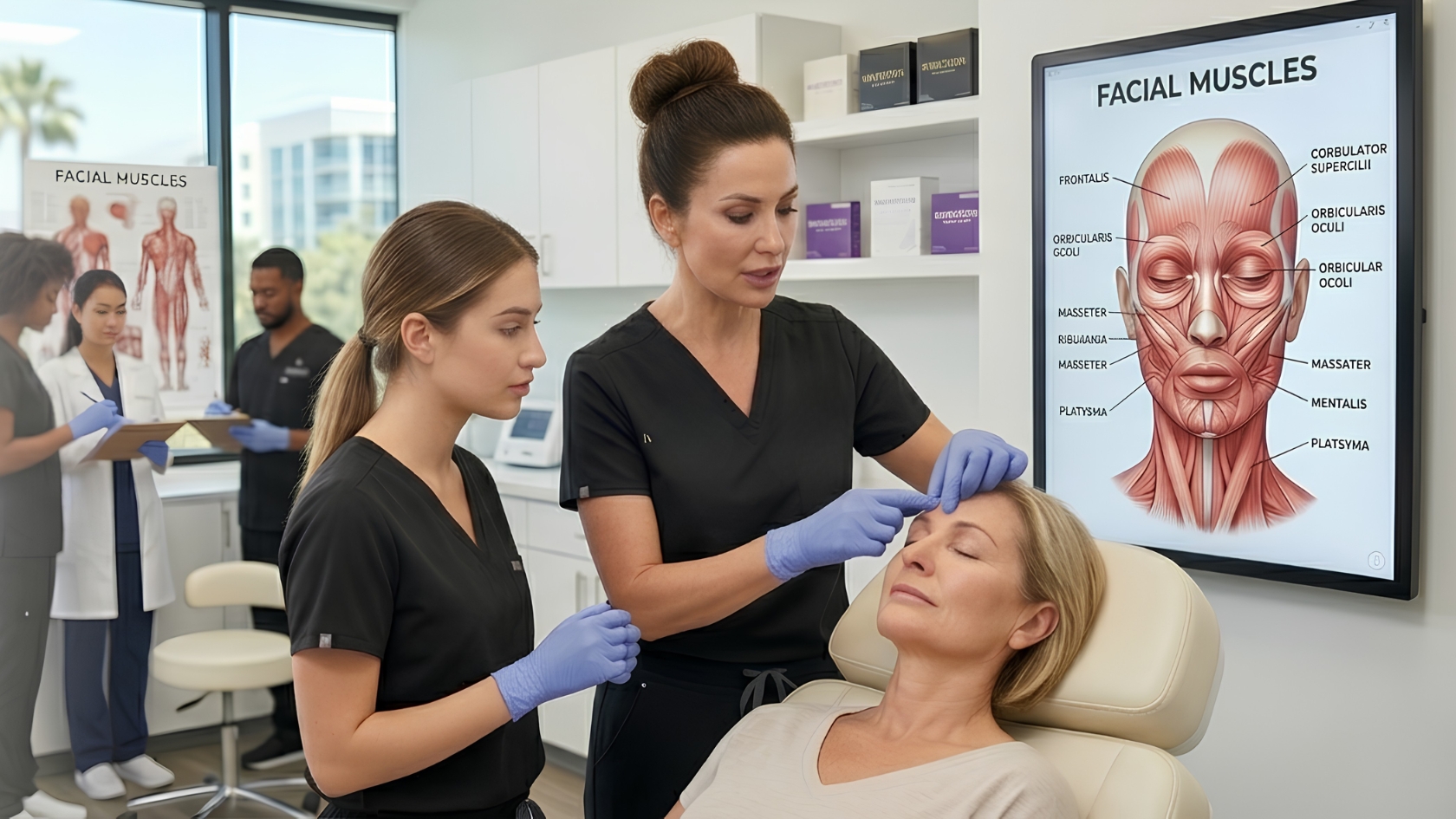
One of the most common mistakes new injectors make is focusing exclusively on the isolated area a patient points to during a consultation.
A patient frequently walks into a clinic saying, “I hate these forehead lines,” or “Can you fix my crow’s feet?” While addressing that specific localized concern is incredibly important, exceptional cosmetic results come from looking far beyond a single wrinkle and assessing the patient’s face as a whole.
At IN Aesthetics Training Academy, we teach our students that successful neurotoxin treatments are never about “chasing lines.” Instead, they require a deep understanding of facial balance, complex muscle movement, structural anatomy, and the patient’s long-term aesthetic goals. The true distinction between a good injector and an extraordinary injector comes down to the ability to evaluate the entire face and design a comprehensive treatment plan that delivers natural, harmonious results.
What Is a Full-Face Approach in Aesthetic Injections?
A full-face approach means conducting a meticulous clinical assessment of all facial zones—including the periorbital, midface, lower face, and neck—before drawing up a single unit of toxin.
Rather than focusing solely on an isolated wrinkle, an advanced injector evaluates the delicate balance between elevator and depressor muscles, as labeled in the anatomy reference above:
- Facial Symmetry & Proportions: Evaluating the balance between the left and right sides, as well as the classic facial thirds.
- Muscle Strength & Movement Patterns: Identifying hyperkinetic muscles (like a strong Frontalis or Orbicularis oculi) and how they pull against neighboring muscle groups.
- Areas of Muscle Compensation: Predicting how relaxing one muscle group might cause an adjacent muscle to work harder.
- Structural Signs of Aging: Assessing how volume loss and skin laxity influence kinetic lines.
- Patient Goals & Tone: Aligning the clinical plan with the patient’s desire for either subtle rejuvenation or distinct structural contouring.
This comprehensive facial assessment allows aesthetic practitioners to identify opportunities to enhance overall facial balance and achieve beautiful, natural-looking outcomes.
Why a Full-Face Assessment Creates Superior Clinical Results
The muscles of facial expression do not work in isolation; they function as a highly complex, interconnected network. When you reduce the contraction of one muscle, an opposing or adjacent muscle often compensates. Treating a single area without mapping out its relationship to surrounding muscle groups can lead to unharmonious, frozen, or heavy results.
The Dynamics of Upper Face Interconnectedness
Consider the upper face: a patient might complain bitterly about horizontal forehead lines. However, if you inject the Frontalis muscle without carefully assessing the Procerus and Corrugator complex (the glabella) or the patient’s natural brow position, you risk dropping the brow. Because the Frontalis is the sole elevator of the upper face, over-treating it without balancing the depressors can leave a patient looking tired or heavy-lidded.
The Overlooked Lower Face and Neck
Similarly, lower-face and neck concerns are frequently overlooked when practitioners limit their scope to traditional upper-face treatments. Hyperactive Masseter muscles can widen the lower face, a strong Mentalis causes chin dimpling, and overactive Depressor Anguli Oris (DAO) muscles create a perpetually downturned mouth. Furthermore, treating Platysmal bands in the neck can drastically sharpen the jawline (the famous Nefertiti Lift).
By assessing the entire face, you treat the root cause of aging patterns rather than just masking the symptoms.
Who Benefits Most from a Comprehensive Assessment?
The short answer: every single patient who walks into your practice.
Every individual deserves a comprehensive clinical evaluation, regardless of whether they ultimately choose to treat a single area or opt for a full-face rejuvenation. However, a full-face treatment plan provides the highest value for patients seeking:
- Holistic, natural-looking facial rejuvenation
- Correction of asymmetric facial features
- Prevention of deep, static wrinkling
- Jawline contouring and slimming
- Advanced neck rejuvenation
- Strategic, budget-conscious long-term aesthetic planning
A thorough consultation uncovers opportunities patients may not have known existed, shifting the conversation from a transactional “per-unit” interaction to a professional, medical-grade consultation.
Mapping the Face: Common Treatment Zones
At our advanced botulinum toxin training courses in California, students master how to visualize and treat the relationships between these key zones:
| Facial Zone | Common Target Areas | Key Anatomical Targets |
| Upper Face | Forehead, Frown Lines, Crow’s Feet, Brow Lift | Frontalis, Glabella Complex, Orbicularis Oculi |
| Mid Face | Bunny Lines, Gummy Smile, Lip Flip | Nasalis, Levator Labii Superioris, Orbicularis Oris |
| Lower Face | Masseter Slimming, Chin Dimpling, Downturned Mouth | Masseter, Mentalis, Depressor Anguli Oris (DAO) |
| Neck & Jaw | Platysmal Bands, Jawline Definition | Platysma Muscle |
Tailoring Neurotoxin Treatments Across Different Age Demographics
An injector’s approach must evolve alongside the natural aging process of the human facial structure.
Patients in Their 20s: The Preventative Era
Younger patients typically present with dynamic lines that disappear at rest. The treatment strategy focuses almost entirely on prevention and micro-dosing. The goal is to soften repetitive muscle movements and preserve a completely natural range of expression before deep, static lines can etch into the skin.
Patients in Their 30s and 40s: Softening and Rejuvenation
During these decades, dynamic wrinkles often begin transitioning into static lines that remain visible even when the face is at rest. Early signs of structural volume loss and minor skin laxity start to appear. Treatment plans generally expand to multiple zones to maintain a refreshed, rested, and balanced appearance.
Patients 50 and Older: Structural Harmony
For mature patients, facial aging becomes a complex interplay of muscle hypertonicity, bone resorption, deep tissue volume loss, and skin laxity. Toxin treatments in this demographic must be meticulously planned so as to not worsen muscle weakness or cause skin sagging. At this stage, botulinum toxin yields the best results when paired thoughtfully with dermal fillers or skin-biostimulating treatments.
Elevating Patient Retention Through Comprehensive Planning
One foundational truth we share with our students at IN Aesthetics Training Academy is that patients do not return to your clinic simply because you know how to inject a needle. They return because they trust your clinical expertise.
When a patient experiences a comprehensive, educational facial assessment, it completely transforms their perception of you. They see you as a highly qualified medical provider rather than a syringe-for-hire. This advanced level of care naturally drives:
- Higher patient return rates for seasonal maintenance.
- Better compliance with multi-session treatment plans.
- Enthusiastic word-of-mouth referrals to friends and family.
Mastering the Full-Face Approach in California
For medical professionals throughout California and across the United States, transitioning to a full-face approach is the single fastest way to elevate patient outcomes and accelerate practice growth. It positions you as an expert authority in facial aesthetics, allowing you to build a loyal, high-value patient base.
If you are ready to move past basic injection patterns and truly master the art of facial assessment, structural anatomy, and customized treatment planning, IN Aesthetics Training Academy is here to guide you.
Our boutique, hands-on medical aesthetics training programs are custom-tailored for Registered Nurses (RNs), Nurse Practitioners (NPs), Physician Assistants (PAs), and Physicians (MDs/DOs) who want to practice with absolute confidence and safety.
About the Author:
Iwona Nasuto, RN, MSN
Founder & Lead Trainer, IN Aesthetics Training Academy
Empowering medical injectors through anatomy-driven safety, clinical excellence, and elite hands-on education throughout California and beyond.